


 Fire
Fire Safety
 Survival
 Protection
 New
New


 Safety
Spring Outdoor Safety Guide: What Most People Forget Before Heading Outside
Spring is here. The grill comes out of storage. The hiking boots get laced up. The backyard finally gets some...
View Article

Summer and grilling go together. The warm evenings, the smell of smoke, the whole family in the backyard. It's one of the best parts of the season.
It's also one of the most common ways homes catch fire.
Fire departments across the United States respond to an average of more than 10,600 home fires involving grills and barbecues every single year. July is the single most dangerous month. Nearly 20,000 people visit emergency rooms annually for grill-related injuries. And most of those incidents weren't caused by recklessness. They were caused by things people didn't think to check.
This guide covers what most people miss. Not the basics you already know, but the overlooked habits, blind spots, and smart tools that separate a fun cookout from a frightening one.

One of the most common mistakes backyard grillers make is treating this summer like last summer. The grill sat outside or in a garage for months. The propane hose aged. Grease hardened inside the burner tubes. Spiders (seriously) built nests inside the venturi tubes that feed gas to the burners.
Insects nesting inside burner tubes is one of the more surprising causes of grill fires, and it happens more often than most people expect. A blocked venturi tube causes gas to back up and ignite outside the burner, sometimes flaring below the grill body where no one is watching. Before you light up for the first cookout of the season, remove the burner covers and inspect the tubes. A flexible bottle brush works well for clearing them out.
Do a full pre-season inspection before the first cookout:
This takes about ten minutes. It can prevent a situation that takes much longer to recover from.

Most people know grease fires are dangerous. Far fewer appreciate how quickly they build up, or how small the spark needed to set them off.
Every piece of meat you put on a grill drips fat. Over a season of cookouts, that fat accumulates in the drip tray, on the flavorizer bars, and inside the bottom of the firebox. Grease that has been heated and re-hardened multiple times has a much lower ignition point than fresh cooking oil. By mid-summer, a grill that hasn't been cleaned can have a layer of accumulated grease that will ignite on its own if the cooking surface gets hot enough.
Clean the drip tray after every two or three uses, not just at the end of the season. Line it with aluminum foil for easy cleanup. Wipe down the flavorizer bars or lava rocks when they're cool. It's a ten-minute job that removes the single biggest fire hazard in your cooking setup.
If a grease fire does happen, the right response is fast and specific. Closing the grill lid cuts off oxygen and often smothers a contained flare-up. Turning off the gas stops the fuel source. What you should never do is use water. Water on a grease fire causes a violent steam explosion that spreads burning oil in every direction.
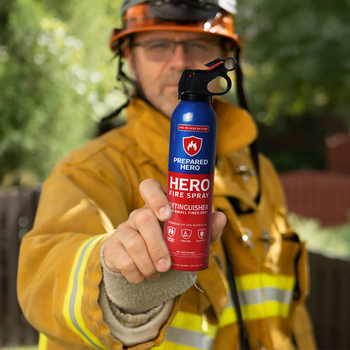
The Prepared Hero™ Hero Fire Spray is designed for exactly this situation. It's a compact, one-handed spray that handles grease fires, wood fires, and more without the dangerous reaction that water causes. Non-toxic, no powder residue, and small enough to keep on the patio table or mounted inside a nearby cabinet. If you grill regularly, it belongs within arm's reach of your setup.


Ask most grillers how far their grill should be from the house and they'll say "a few feet." The actual recommendation is a minimum of ten feet from any structure, including the side of the house, deck railings, fences, pergolas, patio umbrellas, and overhead branches.
That number surprises a lot of people. It feels extreme until you've seen a grease flare reach three feet into the air on a windy day and catch the edge of a canvas umbrella.
A few placement mistakes that cause summer fires most people don't consider:
If you're set up on a deck and can't meet the ten-foot clearance on all sides, at minimum make sure there is nothing flammable directly above you and that the grill is on a non-combustible surface.

Most people grill in whatever they happen to be wearing. A cotton t-shirt and shorts is the standard uniform, and it's mostly fine. But there's one piece of gear that makes a measurable difference in the most common grilling injuries: burns to the hands and forearms.
Grilling gloves are not oven mitts. Standard oven mitts lose their protective quality when they get wet from steam, grease, or sweat. They also cover less of the arm, leaving the wrist and forearm exposed. The Prepared Hero™ Fire Protection Gloves are built with aramid and silicone outer layers that resist heat up to 932°F and extend protection well up the forearm, which is exactly the area that takes the most damage when you're pulling grates, adjusting coals, or moving a flare-up situation.
For the moments when something does catch and you need to act fast, having the gloves already on means the difference between handling the situation and stepping back from it. They're also useful for adjusting the grill grate, moving charcoal, and any other task that puts your hands near sustained heat.


Gas grills dominate the backyard, but charcoal grills still account for a significant share of grill-related fires and injuries every summer. The risks are slightly different, and they catch people off guard.
Never use gasoline or any fuel not designed for charcoal grills. This sounds obvious, but it happens. Gasoline has a wildly different combustion rate than charcoal lighter fluid. A small splash can produce a fireball at lighting. Charcoal lighter fluid only. And only apply it to cold, unlit charcoal, never to coals that are already lit or still warm.
The re-light mistake. If charcoal fails to catch, the temptation is to add more lighter fluid and try again. Liquid that has soaked into partially warm charcoal will ignite immediately and vigorously. If your coals don't light, wait for everything to cool completely before adding fuel.
Disposing of charcoal ash is a slow-burn hazard. Ash from a charcoal grill can retain enough heat to start a fire for up to 48 hours after the last use. Many people dump ash in a trash can, garage bin, or paper bag long before it's actually inert. The only safe method is to soak the ash in water, stir it, and then dispose of it in a metal container. Never in plastic or paper. Never directly on dry ground or near landscaping.
Position the air vents thoughtfully. Charcoal grills regulate temperature through vents on the bottom and lid. Pointing a bottom vent toward dry grass or deck planking concentrates hot air at ground level. Be conscious of which direction heat is being directed when you position the grill.

Most grill fires are survivable and controllable if you respond correctly in the first ten seconds. The problem is that most people haven't thought about what they'd do before it happens, so they freeze, grab the wrong thing, or make it worse.
Here's what to know before you need to know it:
A small flare-up inside the grill: Close the lid. Flares from fat dripping on burners usually starve themselves of oxygen within a few seconds when the lid is shut. Keep the lid closed for at least 30 seconds before reopening.
A grease fire that spreads outside the grill: Turn off all burners. Use the Prepared Hero™ Hero Fire Spray directly on the fire from a safe distance. Do not use water. Do not try to move the grill.
A fire that has caught nearby material: Get everyone away from the area. Call 911 immediately. Don't try to fight a fire that has spread to a structure, fence, or vegetation.
A propane leak fire at the connection: Do not attempt to fight it. Close the propane valve at the tank if you can do so without entering the flame path. Move everyone back. Call 911. A gas-fed fire should not be approached.
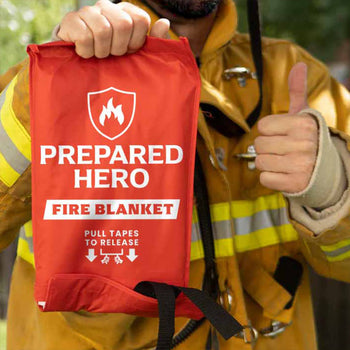
The Prepared Hero™ Emergency Fire Blanket is the right tool when a contained fire needs to be smothered quickly and completely. Pull the tabs, cover the fire, and hold it in place. No training required. No mess. Reusable if undamaged. Many grill-focused households keep both a Hero Fire Spray and an Emergency Fire Blanket near the grill setup so there's always the right tool for the situation.


Most adults know to be careful around the grill. Most kids are simply drawn toward it. Heat, flames, interesting smells, and adults gathered in one place are natural magnets for children. And toddlers don't understand why they can't touch the shiny metal thing.
The NFPA reports that children under five account for around 2,000 grill-related contact burn injuries every year. These aren't from fire. They're from kids bumping into, touching, or falling onto a grill, grill part, or hot coals. The grill surface stays dangerously hot long after the flame is off.
Set a physical boundary, not just a verbal one. Use patio furniture, a folding table, or even a string of flags to create a visible barrier three feet from the grill. Teach every child the rule before the cookout starts, every time.
The grill after cooking is still dangerous. Gas grill grates stay hot for 20 to 30 minutes after the burners are off. Charcoal grill exteriors can stay hot for hours. Don't assume that turning off the grill means it's safe to approach. Cover or move it as soon as it cools enough to handle, and keep children away until it's been confirmed cool.
Pets follow the same logic. Dogs in particular have a habit of investigating the grill, sniffing at drip trays, or brushing against the exterior. Keep them out of the grill zone during and after cooking.

Before your next cookout, take two minutes to make sure you have the right tools in the right places:
At the grill:
On the grill itself:
Around the grill zone:
For charcoal grillers:

The best safety setup is one that doesn't require you to go looking for anything when something goes wrong. That means keeping all your tools in one designated spot near the grill, not in a kitchen drawer, not in the garage, not somewhere you'll have to think about.
Think of it like a first aid kit. You don't move it around. It's always in the same place, always ready, always complete.
Prepared Hero's grilling-ready safety lineup covers exactly this: fire suppression you can spray from a safe distance, a blanket that smothers a contained fire in seconds, and gloves that let you act without burning your hands. Together, they cover every scenario you're likely to face at the grill before a situation becomes something you can't handle.
Check out Prepared Hero's complete fire safety lineup here and build your grill station before the next cookout. It's a one-time setup that protects every summer after it.
Stay prepared, hero!
Do Fire Blankets Work on Grease Fires? Everything you need to know about the safest, most effective way to handle a grease fire before it gets out of hand.
Spring Clean Your Home Safety: A Room by Room Guide A full walkthrough of the safety checks every home needs, including your kitchen, garage, and outdoor spaces.
How Many Smoke Detectors Do I Need? Make sure your home has the right coverage so every fire gets detected as early as possible.
Spring is here. The grill comes out of storage. The hiking boots get laced up. The backyard finally gets some...
Blows down the street, or a heat wave pushes the grid past its limit. Suddenly, your home goes completely dark....
Minor injuries happen when you least expect them. A scraped knee at the playground, a cut while hiking, or a...

#1 Best Seller on Amazon




Join The
Hero Team
Subscribe To Our
Newsletter & Save $5 Today!


 30 N Gould St #37171
  +1 888-457-2672
 support@preparedhero.com
